
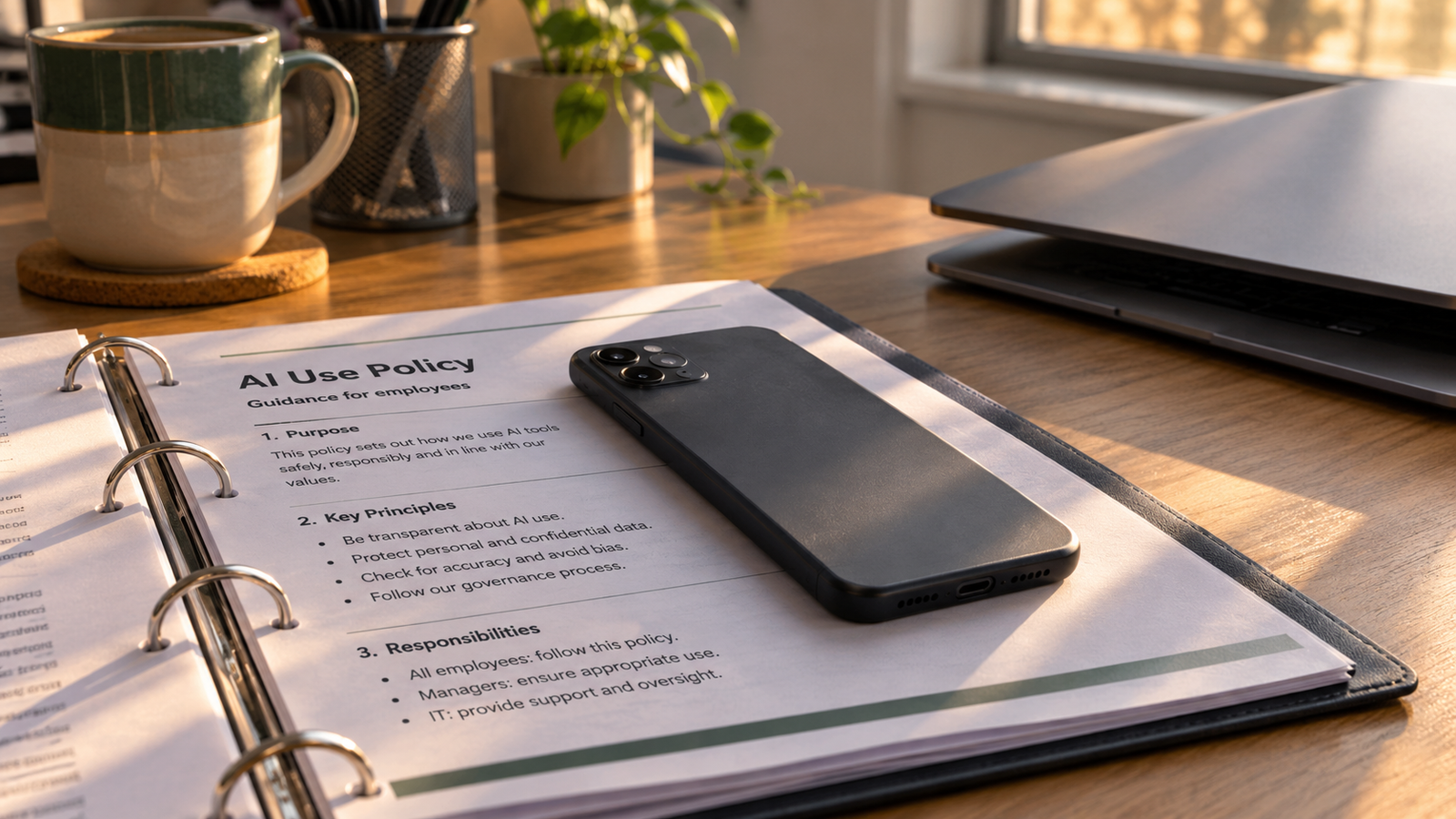
Picture her Tuesday. A complaint lands at 4.40pm from a customer who’s furious and has copied in their MP. Marion has handled hundreds of these. She knows the tone cold. She also knows the Copilot licence on her laptop hides the useful bit behind a menu she’s never found twice, and last time it turned her reply into something that read like a parking fine.
So she picks up her phone. Pastes in the letter, customer’s name and all. Gets a decent draft in eight seconds, tidies it, sends it. Home by half five.
Nobody told her not to. Nobody told her she could. That gap is the whole story.
Her team know. There’s a WhatsApp group where the good prompts get passed round like contraband. In the retro after the Copilot pilot, everyone said the tool was “fine, getting used to it”. The phone workaround never made the notes. It never does.
Then someone on the audit committee asks something simple. Who oversees our AI?
The COO looks at IT. IT points at the licence dashboard, which shows Copilot usage flatlining in Marion’s department. Someone says the word “resistance”. And then everyone looks at you.
You know how that meeting goes. You’ve watched people go “in a meeting” on Teams ten minutes before the actual meeting so they can skip the AI working group. You’ve seen the experienced ones, the people who’ve been right for twenty years, go quiet in training with their cameras off. That isn’t apathy. It’s people who were the expert last month wondering what they are now.
And you know that if you walk in and say “identity threat”, someone will hear “HR fluff” and the conversation’s over.
In July, ChannelNews reported, citing The Information, that Jacob Andreou, the Microsoft EVP now running Copilot, had sent his team an internal memo saying Copilot must “earn the right to exist”. He admitted feature sprawl had confused users. Microsoft is reworking the product.
Sit with that for a second. The company that built the sanctioned tool says the sanctioned tool confused people. Marion wasn’t being difficult. She did what any competent person does when the official kit gets in the way of the job: she found kit that didn’t.
I spent over a decade in the British Army, including three tours of Bosnia. You learn fast that soldiers trust kit they’ve been shown how to use, and they always know whose call it is. Take either away and people improvise. Sometimes brilliantly. Sometimes in ways that end up in a report.
Here’s my stance, and some IT directors won’t like it. Banning personal AI won’t fix this. You’ll just push the phone further under the desk. Shadow AI in the workplace isn’t a discipline problem. People go round the system because nobody drew the lines showing which work AI can touch and who signs it off. Fix the lines and the workarounds lose their reason to exist.
In HORIZON, the Elvorta diagnostic, that’s the Collaboration zones domain. It sounds tidy. In practice it’s a leadership team in a room, arguing about complaint letters.
Run Marion’s story forward. Say the leadership team sits down and decides, out loud, that AI can draft complaint replies once customer names are stripped out, and that a named senior handler signs off anything copied to an MP. IT spends an afternoon making the useful bit of Copilot the first thing you see.
Then someone asks Marion to write the prompt guide, because she’s been quietly doing it better than anyone for months.
Watch what happens to her. The nineteen years stop feeling like a liability and start looking like the thing the tool can’t do. The WhatsApp group goes quiet because the good prompts live somewhere official now. The phone goes back in her bag. Nobody had to confiscate it.
And when the audit committee asks who oversees the AI, the answer is a named person and a page showing what was agreed. That’s an operating decision with an owner. It’s the language your COO already speaks, and nobody can call it fluff.
I’ll be honest about the messy bit. Drawing those lines is uncomfortable. Someone senior has to admit the rollout skipped a step. Someone else has to own a decision they’d rather leave vague. That’s usually where it stalls, and it’s usually where you get blamed.
Your people aren’t resisting AI. They’re waiting for someone to tell them where it’s safe to use it, and right now the only thing telling them is their phone.
So who’s your Marion, and what would she say if you asked her, off the record, what she actually uses to get through a Tuesday?