
That silence, in an ordinary ops review, was the most honest AI adoption report your organisation produced all quarter. Then the meeting moved on.
You know the meeting. The scheduling tool has been live since spring. The slides are green, every one of them: licences used, shifts generated, the vendor’s adoption curve doing what adoption curves are paid to do. Someone from the programme team talks through it with the confidence of a person who has presented the same deck three times.
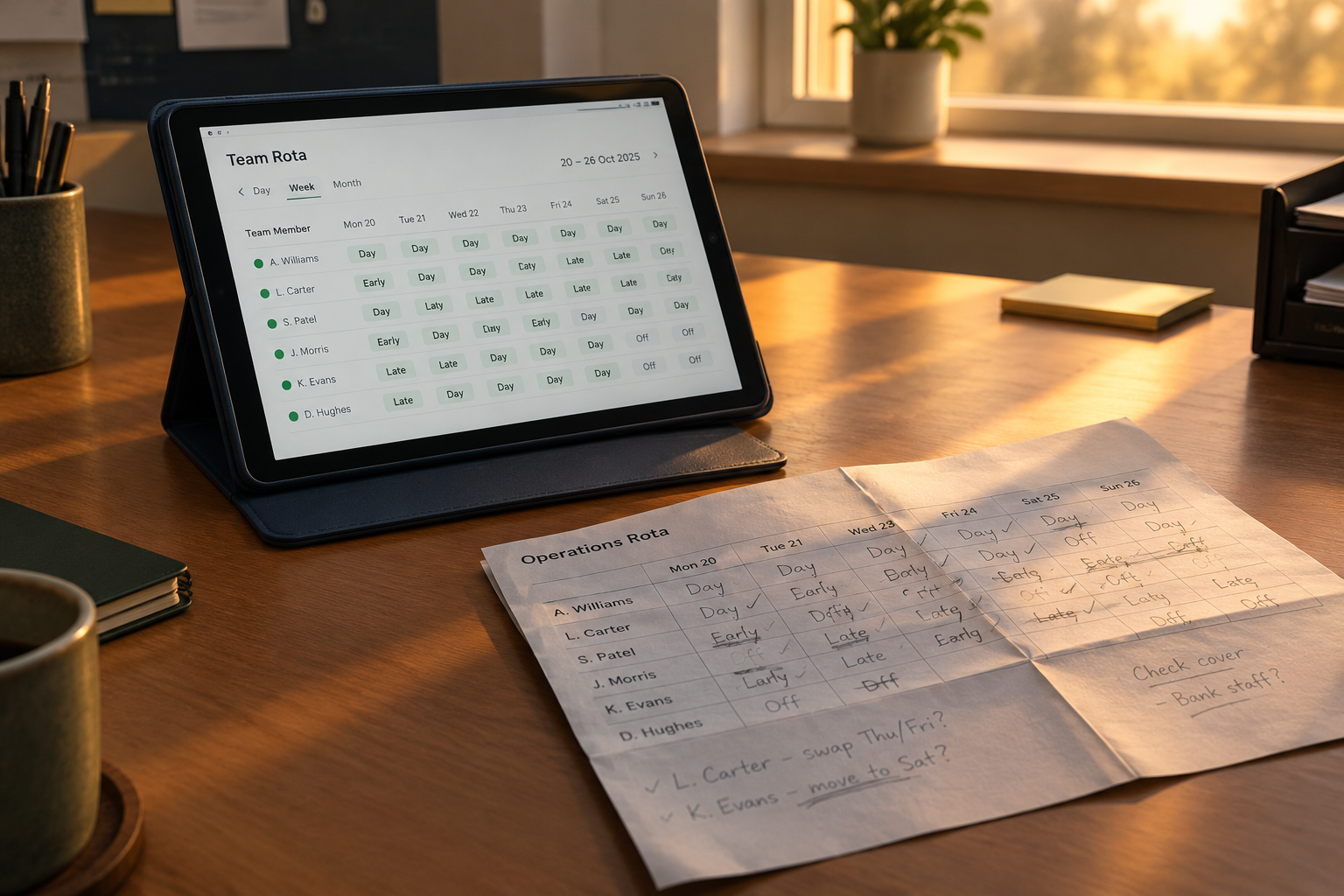
Then a shift lead, half-looking at her coffee, says her team still rebuilds the rota in a spreadsheet every Friday. “Just to be safe.”
She isn’t complaining. She says it the way you’d mention the car park is busy. And for about five seconds nobody in the room says anything at all. The programme lead studies his laptop. Somebody’s pen clicks. You write something down, probably just “Friday?” with a line under it, and the chair says “great, next item”.
My claim is simple and a little uncomfortable. That spreadsheet isn’t resistance, and it isn’t a training gap. It’s the most rational thing in the building, and until you treat it that way, the green slides will keep telling you something that isn’t true.
Think about what happens when the rota is wrong. Not on the dashboard. At twenty to six on a Monday, when two people turn up for one slot and a gap opens somewhere else. The tool doesn’t get that phone call. She does. Her name is on the shift, her standing with her team rests on the rota working, and nobody has told her, in words she believes, who carries the can if the system gets it wrong.
So she keeps a way back. A file called something like rota_FINAL_v3_actual, opened every Friday afternoon, checked line by line against what the system produced. It costs her team a couple of hours a week. It never appears in the retro notes, because nobody asked, and because admitting it feels like admitting you haven’t got on board.
This is where I’ll own a bias. On tour in Bosnia, the formal brief told you what was meant to be true. The useful information usually came afterwards, from whoever was making the brew, said almost in passing. Experienced people protect themselves quietly before they’ll say anything loudly. The spreadsheet is that, in Excel.
That’s the claim, put plainly: AI adoption doesn’t happen when the tool goes live; it happens when people stop keeping a way back.
PwC UK’s latest Hopes and Fears survey points the same way. Daily AI use is climbing, but it sits mostly with senior staff, plenty of users say their workload has gone up rather than down, and a fair few are unsure what their employer’s AI policy actually is or nervous about trying things. Read that next to your Friday spreadsheet. The people closest to the work have more to do and no clear rules, and nobody has told them it’s safe to say so. Of course they keep a copy.
You heard it. That’s not the problem. The problem is what happens when you take it upstairs.
You raise it at the leadership meeting and it gets sorted into a box that already exists. HR calls it change fatigue. The programme sponsor calls it a comms issue and promises a refresher session. Finance asks if it affects the business case, and the honest answer (“yes, a bit, and we can’t see how much”) lands badly in a room that signed off the spend. The sponsor’s Teams status says “in a meeting” for most of the following week.
Nobody is being obstructive. Each of them is being reasonable from their own chair. But the gap between the tool and the actual work doesn’t belong to any of them. IT owns the system. The vendor owns the configuration. Ops owns the shift. Nobody owns the Friday afternoon. And a green dashboard is someone’s project, which makes amber feel like someone’s admission. So it stays green, and you’re left holding the one piece of information that matters, with nobody whose job it is to act on it.
That’s the bit of AI adoption that wears COOs down. Not the problem itself. Being the only person in leadership who can see it clearly, and watching it get politely filed.
It changes when somebody senior names the workaround out loud as a fact rather than a fault, and gives the gap an owner. Usually that means a short, frank conversation about two things nobody has written down: who carries the consequence when the system gets a shift wrong, and what the shift lead can change without asking permission.
When that’s settled, the spreadsheet rarely disappears in one go. It shrinks. The full rebuild becomes a quick check of the tricky shifts, then a glance, then one Friday somebody forgets to open it and nothing breaks. That forgotten Friday is the real go-live date. It won’t be on any slide, and it’s worth more than all of them.
Good strategy only works when people can carry it, trust it, and act on it under pressure.
I’ve watched versions of this in care homes, depots, contact centres and finance teams closing month-end. The tool changes. The Friday spreadsheet doesn’t.
If you’re a COO whose AI scheduling or planning tool went live months ago, whose reports say green, and who knows your teams are still running a shadow version every week because they don’t trust it to hold under pressure, and you can’t get the rest of the leadership team to treat that as a real problem, this is for you.
Elvorta helps leadership teams fix the human reasons their AI tools sit beside the work instead of inside it.
I’m looking for five COOs in exactly that spot. If that’s you, comment below or email info@elvorta.com to request a 30-minute clarity call, and we’ll talk about your Friday spreadsheet, not my slides.
If you’re not ready to talk yet, the free HORIZON scorecard gives you a red, amber, green read across the seven areas, including how well AI lives inside day-to-day work: AI Adoption Scorecard – Elvorta
Your teams have already told you where to start. They just put it in a spreadsheet instead of a slide.
So what’s the one workaround in your operation that everyone knows about and nobody has written down, and who would need to be in the room for it to finally get an owner?