Horizon
The tool was never the problem. The system around it was.
It does not audit the model. It audits the trust, workflow, authority, and habits of the people meant to use it
70% - 90%
7
3
The adoption gap
Closing the adoption gap is not a matter of motivation, enthusiasm or better slides. It is a design job.
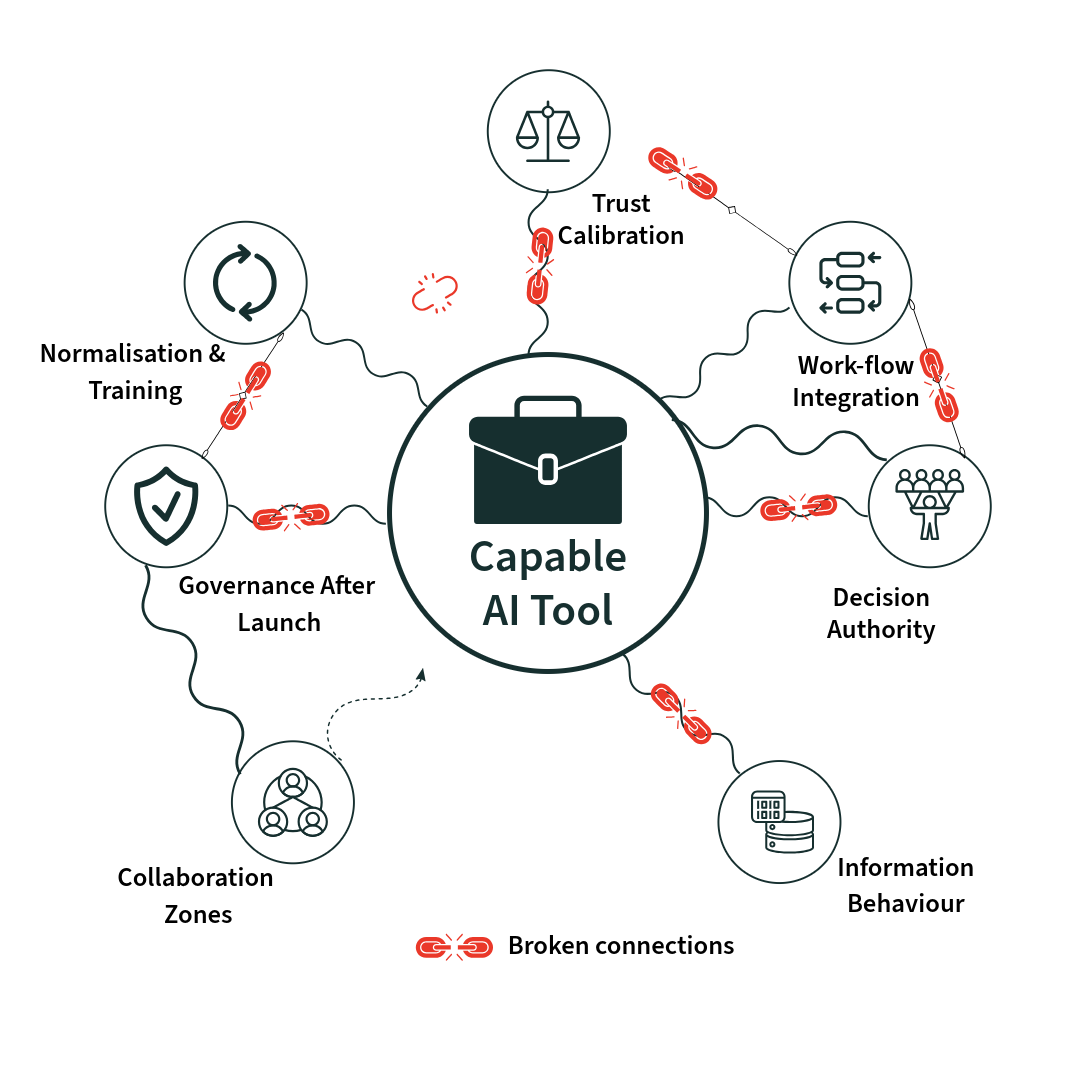
What actually kills a good tool
Meet Horizon
Examine the system, not the tool
LEVEL 01 · DIAGNOSE
Find the gaps
LEVEL 02 · DESIGN
Match the fix to the cause
LEVEL 03 · EMBED
Make it survive without heroics
Scoring
Red, amber, green
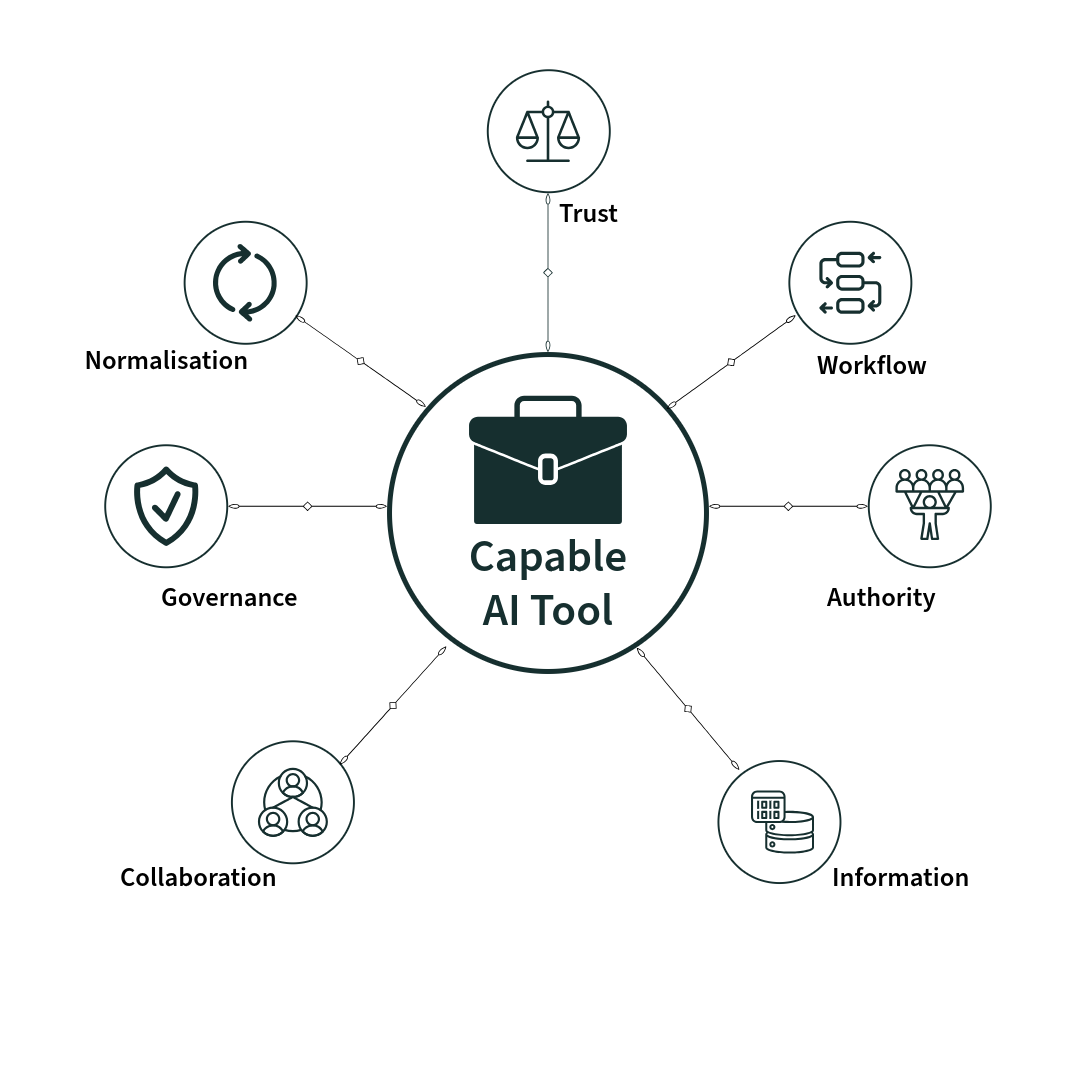
The seven domains
Where AI adoption tends to break
Do people trust the tool the right amount, neither ignoring it nor deferring to it blindly?
Signs it's amber or red
- The team tells one war story about the tool's worst miss often.
- Staff check every answer so thoroughly the tool saves no time at all or nobody checks anything.
- Usage splits sharply by person, suggesting trust is set socially, not on merit.
What good looks like
People can tell you specifically where it's strong and where it's shaky, trust is calibrated, not maximised, and anchored in the tool's real track record.
Miscalibrated trust rarely gets said out loud. Flagging that a tool is unreliable, or admitting you've stopped using it, can feel like a career-limiting move in a room full of people championing the rollout. If raising a concern here feels risky, that's a psychological safety problem wearing a trust costume, and it needs to be named as such, not just scored as red
The fix
Show the real track record; name the vivid early miss instead of letting it become folklore.
Does the tool live inside the real flow of work, or off to one side in a tab people have to remember to open?
Signs it's amber or red
- Using it means a separate app, site or login away from the main system.
- People copy-paste between the tool and their real work, the smell of a workflow seam.
- Usage is high in week one and falls steadily.
What good looks like
The tool appears at the moment of need, in place; people already are. Using it is the path of least friction; the new way has fewer steps than the old one
The fix
Bring the tool into the main flow; remove steps rather than adding them.
Is it clear who decides, who approves, who escalates and what happens when a human and the tool disagree?
- People hesitate to act on the tool's advice, unsure if they're allowed to.
- When the tool and a person disagree, there's no rule for what happens next.
- After something goes wrong, nobody can establish who was supposed to act.
What good looks like
Every person can say, without hesitation, what they're allowed to decide alone, what needs a second pair of eyes, and who they escalate to.
The fix
Write one line: who decides, who owns it, and what happens on disagreement.
Is the information going in, and what people do with what comes out — good enough to rely on?
Signs it's amber or red
- Intake fields get filled minimally, late, or not at all under pressure.
- The tool's answers aren't recorded, so nobody downstream knows what it advised.
- The same information gets entered in several places, badly, everywhere.
What good looks like
Capturing good input is easy at the moment people have the information. Answers travel with their caveats, three steps downstream.
The fix
Fix the inputs upstream; simplify the form to what actually matters.
Is it clear what the AI does alone, what humans do alone, and what they do together?
Signs it's amber or red
- People and the tool sometimes do the same work, unaware of each other.
- Things fall through because each assumed the other had it.
- Newer staff can't cope when the tool gets it wrong; the underlying skill was never protected.
What good looks like
Every person can describe the three zones for their work in a sentence. Hand-offs are visible in both directions.
Badly drawn zones don't just create duplicated work; they threaten identity. When the tool quietly absorbs the judgement call on which someone built their professional reputation, the resistance that follows isn't about the tool. It's someone protecting who they are at work. Redrawing the zones on purpose, with the people affected in the room, is what turns identity threat back into a defined, respected role.
The fix
Redraw what's handed over; route the right cases back to humans on purpose.
Does anyone own the tool, watch it, and review it once the launch excitement has faded?
Signs it's amber or red
- You can't name the person responsible for the tool today.
- Nobody has checked its accuracy or usefulness since launch.
- "Is it still working well?" Gets a shrug or an assumption.
What good looks like
A named owner holds the remit. A light, real, scheduled review asks whether it's still accurate, used, trusted, and suited to the business as it is now.
The fix
Name an owner; set a recurring review with a route to retrain, adjust or retire.
Has the new way become simply the way things are done, supported by training that matches reality?
Signs it's amber or red
- The old way is still available and is what people revert to under pressure.
- Training was a one-off near launch, with no refresh.
- Usage depends on a champion and dips when they're away.
What good looks likes
The new way is what new starters are taught as standard, and what the team now finds strange to work without. The old way has been retired on purpose
The fix
Retire the fallback; train for the real job, not the feature list.